

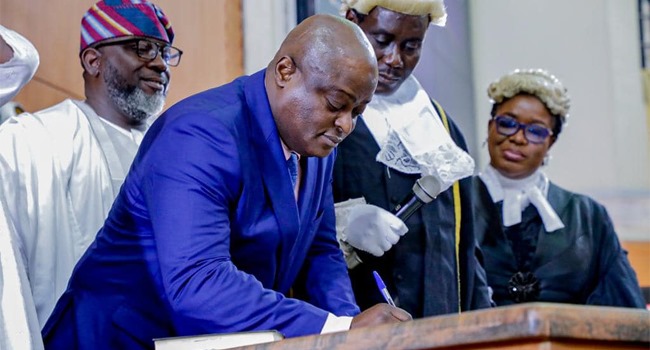

By Hassanat Adebowale
Justice Yetunde Pinheiro of the Ikeja High Court has reserved judgment in the legal battle initiated by Mudashiru Obasa, the reinstated Speaker of the Lagos State House of Assembly, challenging the legality of his earlier removal from office.
The judgment date will be communicated to the parties after the court heard over 15 preliminary applications from the respondents, who include members of the state assembly and former Speaker Mojisola Meranda.
Obasa’s removal on January 13 was based on allegations of fraud, high-handedness, abuse of office, and gross misconduct. However, he was reinstated as Speaker on March 3 following Meranda’s resignation. Obasa is now seeking a court ruling to nullify the January 13 proceedings, which he claims were unconstitutional.
During Monday’s hearing, Obasa’s counsel, Prof. Joshua Olatoke (SAN), argued that the assembly was on recess when the lawmakers convened the January 13 session without notifying either the Speaker or the Majority Leader, who hold the authority to reconvene sessions during recess. Olatoke urged the court to assume jurisdiction over the matter and nullify the proceedings, stating, “The constitutionality of that plenary must be fully determined.”
Representing the respondents, Mr. Femi Falana (SAN) contended that the March 3 proceedings, which reinstated Obasa as Speaker, had rendered the case moot. He argued that the assembly has the constitutional right to appoint and remove its principal officers without judicial interference. Falana also claimed that Obasa’s suit lacked a pre-action notice, making it procedurally flawed.
Mr. Olu Daramola (SAN), representing additional respondents, maintained that the January 13 session was valid, as the decision to remove Obasa was supported by more than the required two-thirds majority of assembly members. Conversely, Mr. Clement Onwuenwunor (SAN), representing other respondents, argued that the session violated assembly rules, empowering the court to intervene.
Counsel for Meranda, Mrs. Abimbola Akeredolu (SAN), described the suit as an abuse of judicial process, given Obasa’s reinstatement and Meranda’s return to her previous role as Deputy Speaker.
Justice Pinheiro adjourned the case, emphasizing the need for a thorough review of the arguments presented. The court’s decision will determine whether Obasa’s removal was lawful or if the January 13 proceedings should be invalidated.
GI’s Legal Corner
According to the Nigerian constitutional law, state legislatures have the authority to elect and remove their leaders, as long as they secure the required two-thirds majority, as outlined in the 1999 Constitution (as amended).
However, when claims of procedural irregularities arise, especially those concerning fair hearing and due process, the judiciary may need to step in. This case could play a key role in defining the boundaries between legislative independence and judicial oversight in Nigeria’s democratic system.
Dear readers, we really need your support to keep on serving you with authoritative, truthful, and juicy stories everyday. For your support, please reach out to the editor @gavelinternational66@gmail.com