

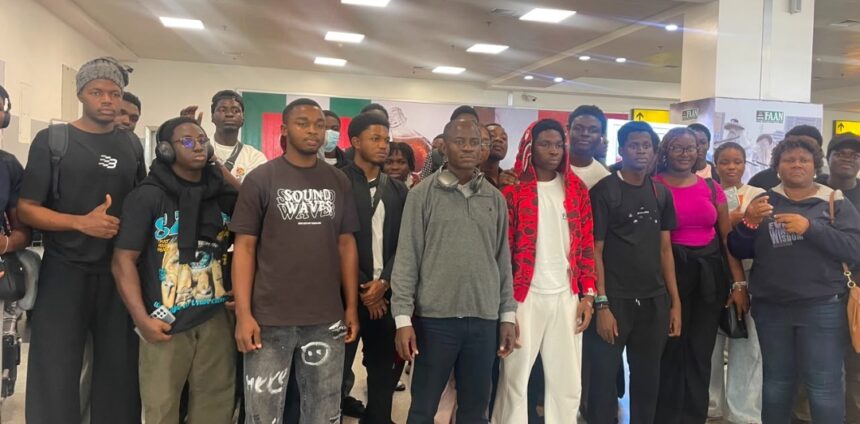

For 37 engineering students from Afe Babalola University (ABUAD), Ado-Ekiti, the true meaning of engineering shifted permanently from the abstract pages of classroom textbooks into the tangible reality of a high-tech industrial environment.
The undergraduates, accompanied by two of their lecturers, arrived at the Murtala Muhammed International Airport in Lagos on Saturday following a rigorous 20-day advanced practical training stint at the Zhejiang Polytechnic University of Mechanical and Electrical Engineering in Hangzhou, China.
The pioneering student exchange initiative focused on Intelligent Manufacturing and Control Technologies, deliberately structured to rescue Nigerian engineering education from the limitations of pure theory and expose the participants to global best practices.
Speaking on the journey, the Provost of ABUAD’s College of Engineering, Professor Moses Onibonoje, described the experience as a transformative milestone for both the students and the faculty.
He explained that the participants had already completed a rigorous three-month theoretical foundation in Nigeria, which allowed them to adapt almost instantly to the sophisticated Chinese laboratories.
Once there, the students were immersed in hands-on operations, working directly with programmable logic control systems, digital twin laboratories, robotic arm design technologies, advanced computer numerical control machines, three-dimensional printers, and complex metrology equipment.
Professor Onibonoje noted that beyond the raw technical skills acquired, the trip injected a deep sense of cultural discipline into the students and widened their professional horizons, thanking the university’s founder, Aare Afe Babalola SAN, for creating a partnership that has now opened doors for future academic exchanges and postgraduate scholarships.
While the students adaptability was highly praised by faculty members like Dr Imhade Princess Okokpujie, an Associate Professor of Mechanical Engineering, the trip also served as a stark reminder of the infrastructure deficit back home.
Dr Okokpujie observed that while Nigeria has made commendable progress in engineering education, matching the technological heights seen in China will require aggressive, deliberate investments in local laboratory facilities and technology-driven learning spaces.
The returning undergraduates shared this sentiment, describing the trip as an eye-opening reality check that brought their academic paths to life. Adeniji Adam Opeyemi, a final-year Mechanical Engineering student, remarked that operating heavy industrial machinery that he had previously only encountered in diagrams was an exceptional shift.
He pointed out that the strength of the Chinese educational model lies in prioritising workshop practice over passive classroom lectures, urging Nigerian authorities to equip local universities so that domestic graduates can compete fairly in the global tech market.
For Judith Obioha, a final-year Mechatronics student, the highlight was the sheer abundance of modern equipment, which ensured that every student could work independently without crowding. Combined with lessons in Chinese language, culture, and infrastructure, the immersive programme successfully fulfilled ABUAD’s broader mission to equip its graduates with the specialized, real-world skills required to dominate emerging global industries in automation and robotics.
Dear readers, we really need your support to keep on serving you with authoritative, truthful, and juicy stories everyday. For your support, please reach out to the editor @gavelinternational66@gmail.com