

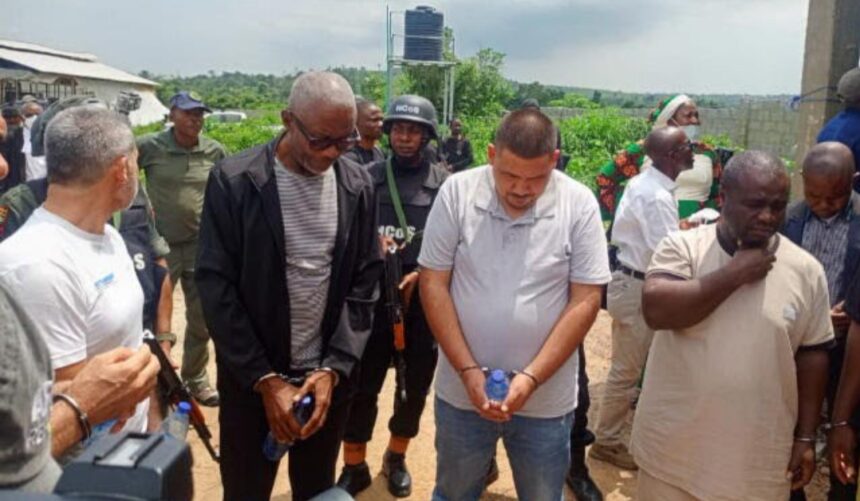

…Says Defendant Are Flight Risk
Justice Akintayo Aluko of the Federal High Court, Lagos, has denied bail to three Mexican nationals and seven Nigerians standing trial over their alleged involvement in the establishment and operation of a clandestine methamphetamine laboratory in Ogun State, citing the risk that some of them may abscond and evade trial.
The judge held that the defendants represented by their counsel Chief Benson Ndakara failed to place sufficient materials before the court to justify the exercise of its discretion in their favour, stressing that bail in criminal proceedings is discretionary but must be exercised judicially and judiciously.
The defendants are Juan Carlos Meza Torrero, Nemecio Martinez Felix, Jesus Lopez Valles, Anochili Innocent, Nwankwo Sunday Christian, Egwuonwu Uchenna Victor, Igwe Abuchi Remijus, Ifeanyichukwu Chibuike Joshua, Omonughwa Kingsley Orike and Emeka Christopher Nwobum.
They are facing an 11-count charge filed by counsel to the National Drug Law Enforcement Agency (NDLEA) over their alleged involvement in the production and trafficking of methamphetamine and the acquisition and transportation of precursor chemicals used in its manufacture.
The prosecution alleged that the defendants were behind a clandestine laboratory in a forest at Iloti Village, Ijebu East Local Government Area of Ogun State, where 2,419.48 kilogrammes of methamphetamine, with an estimated international street value of more than N480 billion, was allegedly produced.
In his ruling, Justice Aluko held that bail could be refused where there were reasonable grounds to believe that an accused person might commit another offence, interfere with the investigation or trial, destroy or frustrate the proper investigation of an offence, or otherwise undermine the administration of justice.
He stressed that one of the primary purposes of bail was to ensure that an accused person remain available to face trial.
According to Justice Aluko, where there was reason to believe that an accused person might abscond, the trial court was entitled to refuse bail.
Justice Aluko said the prosecution led by Mr Buhari Abdullahi had raised specific allegations in its counter-affidavit which were relevant to the determination of whether the defendants should be released.
The trial judge observed that some of the allegations were not effectively denied by the defendants.
The judge further noted that some of the defendants admitted that chemicals had been recovered from their possession, although they claimed that the chemicals were intended for legitimate purposes and were not connected with the alleged production of methamphetamine.
Relying on judicial authorities, Justice Aluko held that failure to effectively deny material facts contained in a counter-affidavit could amount to an admission of those facts.
He consequently held that the allegations which the defendants failed to effectively controvert constituted sufficient material for the court to decline to exercise its discretion in their favour.
The judge also rejected the defendants’ reliance on alleged medical conditions as a basis for securing their release.
Justice Aluko noted that the defendants had failed to attach medical reports to substantiate their claims of ill health.
He further found that there was no evidence before the court suggesting that the correctional facility was incapable of providing adequate medical care or otherwise accommodating the defendants’ needs.
“The application for bail is not well made out,” the judge held.
Justice Aluko also referred to decisions of the Court of Appeal cautioning trial courts against granting bail where there was reason to believe that an accused person was likely to abscond and evade trial.
He further relied on the Supreme Court decision in Bamaiyi v. State, particularly its emphasis on safeguards within the criminal justice system for the prosecution, accused person and victim.
According to the judge, those safeguards recognise the need to ensure that an accused person awaiting trial remains available to face proceedings and does not interfere with the administration of justice.
Justice Aluko said where there was good reason to believe, or strong suspicion, that an accused person might abscond or interfere with the administration of justice, the court was entitled to take appropriate measures within its jurisdiction.
He, however, observed that one safeguard available in such circumstances was the acceleration of the trial.
The judge noted that the substantive case had already been ordered to proceed on an accelerated basis and that trial had commenced.
He said the prosecution had already called its first witness before Justice Musa Kakaki, who is presiding over the substantive trial.
In the circumstances, Justice Aluko held that the defendants had failed to establish sufficient grounds for the grant of bail.
He accordingly dismissed the bail applications and ordered that the defendants remain in custody pending the continuation of their trial.
Counsel to the defendants, Chief Benson Ndakara, had earlier urged the court to grant bail, arguing that the defendants’ continued detention violated their fundamental rights.
Ndakara argued that the offences were bailable and that the defendants were presumed innocent until proven guilty by a court of competent jurisdiction.
He said the first defendant, Anochili, was unjustifiably detained because no hard drug was found on him at the time of his arrest.
The lawyer also argued that the defendants were not establishing a methamphetamine laboratory at the site but were allegedly putting structures in place for poultry farming, piggery and alcoholic-wine production.
He assured the court that the defendants were ready to provide reliable sureties and comply with any conditions imposed by the court to guarantee their attendance at trial.
The defence also raised the alleged deteriorating health of some of the defendants, arguing that they required special medical attention.
But counsel to the NDLEA, Barrister Buhari Abdullahi, urged the court to reject the applications, describing the defendants as flight risks.
Abdullahi argued while arguing his counter affidavit said there was no exceptional urgency warranting the defendants’ resort to the vacation court because the substantive criminal proceedings were already before Justice Kakaki.
He told the court that the defendants had been arraigned, their plea taken and an order made for accelerated hearing of the case.
The prosecutor said the prosecution had already called its first witness, who had testified, and that the trial was continuing.
Abdullahi particularly relied on the international composition of the defendants in opposing bail.
He pointed out that three of the defendants were Mexican nationals, while Anochili, whom the prosecution described as the alleged financier and organiser of the operation, was a dual Nigerian-Mexican citizen.
He argued that releasing the defendants could provide an opportunity for them to leave the country and frustrate the trial.
On the medical claims, Abdullahi said the defendants had failed to establish that their alleged health conditions were beyond the capacity of the medical facilities at the correctional centre.
The prosecutor also rejected the defence claim that the facility where the alleged laboratory was discovered was intended for legitimate businesses.
He told the court that NDLEA investigations showed that the facility was allegedly owned, financed and sponsored by Anochili and had been established and equipped for the illicit production of methamphetamine.
According to Abdullahi, NDLEA operatives recovered various equipment, apparatus, chemicals and materials allegedly associated with the production of controlled substances from the facility.
He specifically mentioned Phenyl-2-Propanone (P2P), which he described as a major precursor agent for the production of methamphetamine.
The prosecution further alleged that the defendants were part of an organised network involved in the illicit production and trafficking of methamphetamine, as well as the acquisition, transportation and processing of precursor chemicals.
The agency said the international composition of the group demonstrated the alleged transnational character of the criminal enterprise.
The defendants, however, denied the allegations and remain presumed innocent until proven guilty.
It would be recalled that the defendants were brought before Justice Musa Kakaki on an 11-count charge bordering on conspiracy, establishment of an illegal drug laboratory, production of methamphetamine and other drug trafficking-related offences.
The defendants were arrested during coordinated operations in Ogun and Lagos states between May 16 and May 18, 2026.
The defendants were alleged to have established a “super clandestine laboratory” in Mowe village, Ijebu East Local Government Area of Ogun State, where they produced 2,419.48 kilograms of methamphetamine with an estimated international street value exceeding N480 billion.
NDLEA said operatives raided the laboratory hidden inside a forest in Mowe on May 16, arresting four Nigerian suspects alongside the three Mexican nationals, who were described as methamphetamine production experts
Dear readers, we really need your support to keep on serving you with authoritative, truthful, and juicy stories everyday. For your support, please reach out to the editor @gavelinternational66@gmail.com