

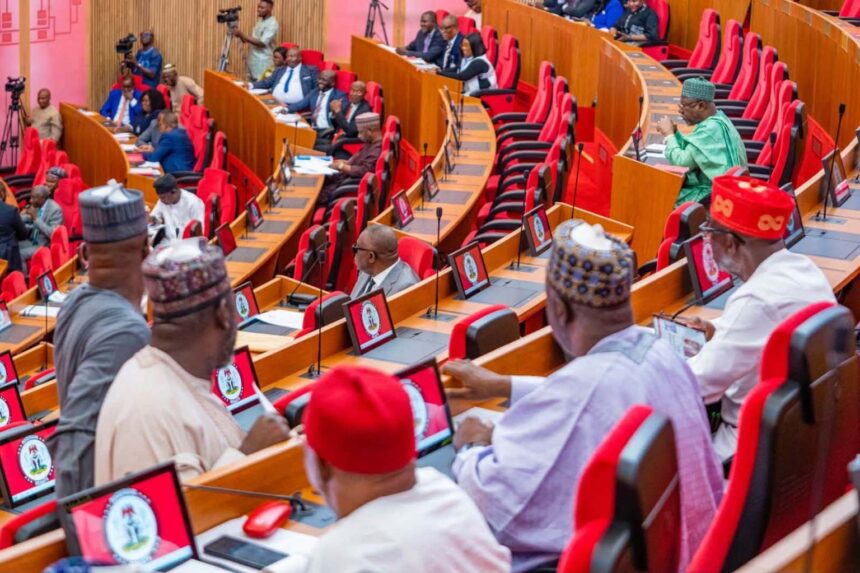

The Nigerian Senate has called on the Nigeria Police Force to investigate rising cases of political violence ahead of the 2027 general elections and urged the Independent National Electoral Commission (INEC) to enforce statutory sanctions, including disqualification, against candidates linked to electoral violence.
The resolution followed a motion sponsored by Senator Abdul Ningi, representing Bauchi Central, during plenary, where lawmakers condemned recent attacks targeting prominent political figures and their supporters across the country.
Presenting the motion, Ningi cited the incident in which President Bola Tinubu’s motorcade was reportedly pelted with stones and other objects as it departed the Shehu Shagari Central Mosque in Garki, Abuja, after Jumu’ah prayers. The attack reportedly damaged vehicles and left security personnel injured.
He also highlighted reported attacks on Nigeria Democratic Congress (NDC) presidential candidate Peter Obi in Edo State, the disruption of an NDC and Obidient Movement procession in Asaba, Delta State, on November 7, which left one person dead and five others injured, and an assault on the convoy of African Democratic Congress (ADC) presidential candidate Atiku Abubakar in Sokoto State.
The upper chamber urged Inspector-General of Police Olatunji Disu and other relevant security agencies to conduct impartial investigations into the incidents, identify and publicly expose those behind the attacks, and prosecute everyone found culpable.
Seconding the motion, Senator Ali Ndume, representing Borno South, described the attack on the President’s convoy as a national embarrassment rather than a personal affront to Tinubu.
He argued that the President’s democratic restraint had prevented more serious consequences for the 78 suspects initially arrested in connection with the incident, who were subsequently granted presidential clemency.
Ndume also proposed banning the possession of weapons, including knives and sticks, at political rallies and called for the establishment of special courts to fast-track the prosecution of electoral offenders.
“What we need to do as a Senate is to stand up strongly against any form of violence. Last week, what happened to Mr President is not an embarrassment against the president; it is an embarrassment to Nigerians. On a Friday, in a Mosque, it is wrong,” he said.
During the debate, Senator Kawu Sumaila, representing Kano South, moved an amendment to reduce the period given to the relevant Senate committees to submit their reports from four weeks to one week.
He also opposed the proposal for special courts at campaign grounds, arguing instead that candidates should be held directly accountable when their supporters carry dangerous weapons.
Senator Abba Moro, representing Benue South, called for the enforcement of existing provisions of the Electoral Act to prevent violence from discouraging voters and undermining participation in elections.
He warned that insecurity could lead to widespread voter disenfranchisement if citizens became too afraid to visit polling stations.
“If this is not nipped in the bud, then certainly, our election and electoral process will be in danger. It will cause voter disenfranchisement; voters will be so scared even to vote; what then will become of our democracy?” Moro asked.
Meanwhile, Senator Babangida Hussaini, representing Jigawa North-West, urged INEC to disqualify candidates found responsible for electoral violence, citing Sections 121 to 128 of the Electoral Act 2026.
Senator Binos Yaroe, representing Adamawa South, also secured an amendment calling on state governors to provide opposition political parties with unrestricted access to public facilities, including stadiums and hotels, for campaign activities.
After considering the motion and its amendments, Senate President Godswill Akpabio put them to a voice vote, and they received overwhelming support.
Akpabio subsequently urged the Federal Government to direct security agencies to strengthen protection for political leaders and gatherings across the country through effective early-warning and rapid-response mechanisms.
He also cautioned parents and young people against participating in attacks on national leaders, warning that such actions could attract serious legal consequences, including charges of treasonable felony.
Dear readers, we really need your support to keep on serving you with authoritative, truthful, and juicy stories everyday. For your support, please reach out to the editor @gavelinternational66@gmail.com