
• Says university must produce knowledge, skills, healthcare solutions
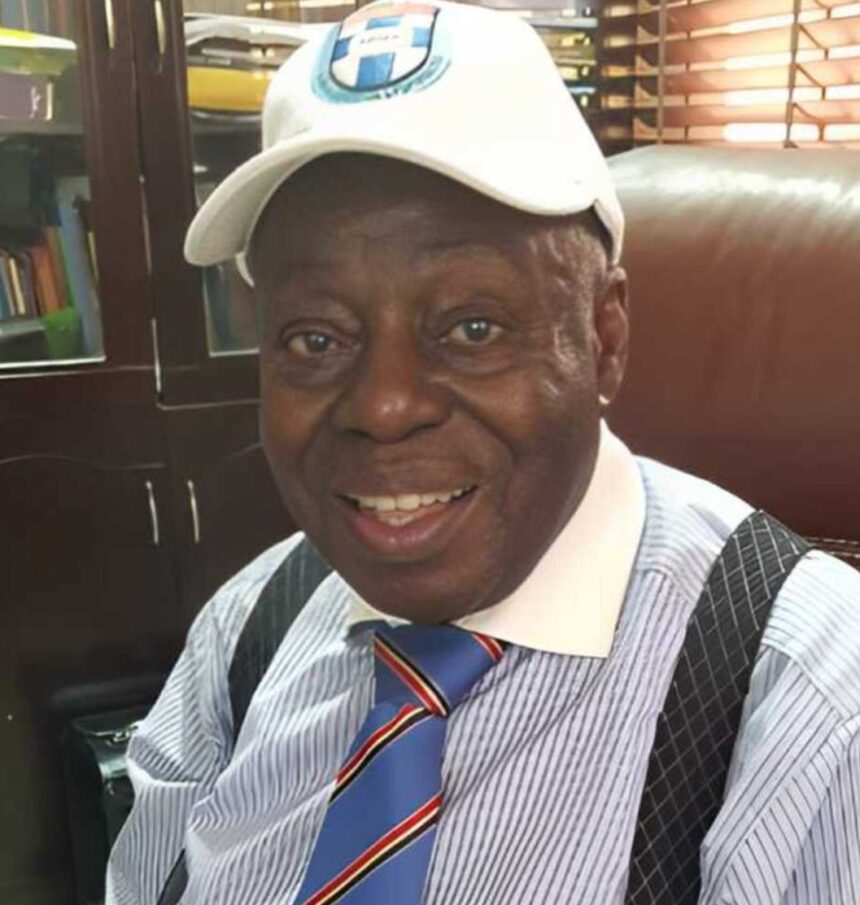
The Founder and Chancellor of Afe Babalola University, Ado-Ekiti (ABUAD), Aare Afe Babalola, has declared that Nigeria’s education and healthcare challenges can only be effectively tackled by building institutions that combine quality teaching, cutting-edge technology, research and specialised medical services.
Babalola spoke on Tuesday in Ado-Ekiti at the 19th International Conference of the Nigeria Association of Nephrology Nurses, hosted by ABUAD, where he used the university and its multi-system hospital to demonstrate what he described as the possibilities of marrying education with healthcare delivery.
He said his decision to establish ABUAD was largely informed by his experience as Pro-Chancellor and Chairman of the Governing Council of the University of Lagos, where he encountered deep-rooted problems in the Nigerian university system.
Babalola, who served at UNILAG between 2001 and 2005 and later continued his reform efforts, said he discovered that many public universities were hampered by inadequate infrastructure, poor accountability and declining academic standards.
He said he therefore resolved to establish a university that would provide quality lecturers, modern laboratories, functional infrastructure and a conducive academic environment.
According to him, his reforms at UNILAG included tackling cultism, improving accountability, stabilising the academic calendar, introducing student and staff awards, establishing income-generating units, expanding hostel accommodation and reclaiming university land from encroachers.
He also said he introduced the Post-UTME screening system after discovering that some candidates admitted through the Joint Admissions and Matriculation Board could not defend the high scores they presented or cope academically after admission.
Babalola said the system subsequently helped universities identify academically deficient candidates before they became students.
He added that he established an endowment scheme at UNILAG through which donations were invested to generate income for scholarships, with 500 scholarships awarded in February 2006 alone.
The legal icon said the lessons from UNILAG shaped the establishment of ABUAD, which he described as his attempt to demonstrate what a Nigerian university could achieve when education was backed by adequate infrastructure, technology and strong management.
He said ABUAD had within a relatively short period earned recognition from the National Universities Commission, the Association of Vice-Chancellors of Nigerian Universities and UNESCO.
But beyond academic excellence, Babalola said the university deliberately developed a healthcare component capable of supporting medical education, research and advanced clinical practice.
He drew attention to the 400-bed ABUAD Multi-System Hospital, which was commissioned in 2017 and commenced clinical operations on March 21, 2018.
The hospital, he said, has grown from its initial radiodiagnostic and accident and emergency services into a major specialised healthcare facility with advanced diagnostic equipment, including MRI and CT scanners, mammography, fluoroscopy, digital X-ray, bone densitometry, ultrasonography, echocardiography, treadmill testing and a cardiac catheterisation laboratory.
Its expanding range of services includes fertility treatment and in-vitro fertilisation, neurosurgery, spine surgery, orthopaedics, joint replacement, urology, ophthalmology, oncology, cardiology, nephrology, endocrinology, neurology, paediatrics, obstetrics and gynaecology, mental health and rehabilitation.
Babalola said the hospital had enabled patients who previously had to travel long distances in search of sophisticated diagnosis and treatment to access such services in Ado-Ekiti.
The Vice-Chancellor of ABUAD, Prof. E. Smaranda Olarinde, reinforced the connection between education and healthcare, saying the hospital’s achievements were evidence of the institution’s philosophy of integrating education, research, technology, innovation and clinical practice.
Olarinde disclosed that nurses at the hospital had performed more than 60 successful kidney transplants, while the hospital had also recorded notable achievements in renal and reproductive health, open-heart and complex cardiac surgeries, advanced surgical interventions and critical care.
She challenged nephrology nurses and other healthcare professionals to continually update their knowledge as artificial intelligence, digital health and other emerging technologies reshape medical practice.
The Vice-Chancellor, however, warned that technological advancement must not come at the expense of compassion and human dignity.
She said healthcare professionals must remain competent and technologically adept while retaining the empathy, sound judgment and respect for patients that are central to quality healthcare.
Olarinde commended the Nigeria Association of Nephrology Nurses, Ekiti State Chapter, for sustaining the scientific conference for 19 editions, urging participants to convert the knowledge and experience shared at the conference into better care for kidney patients.
She also highlighted ABUAD’s recent performance in global university rankings, noting that the institution was rated Nigeria’s number-one university for the fifth consecutive year, from 2022 to 2026, in the Times Higher Education Sustainability Impact Ratings. It was also ranked second in Africa and 72nd globally among 1,646 participating universities across 116 countries.
For Babalola, the achievements represent the fulfilment of a vision born out of his dissatisfaction with the shortcomings he encountered in Nigeria’s university system.
He expressed satisfaction that ABUAD had produced graduates who were now occupying prominent positions around the world, with some becoming employers of labour.
He said the university’s experience had demonstrated that education could be a powerful platform for solving wider national problems, particularly when academic knowledge was connected to technology, research and practical healthcare delivery.
Dear readers, we really need your support to keep on serving you with authoritative, truthful, and juicy stories everyday. For your support, please reach out to the editor @gavelinternational66@gmail.com