



How Senator Natasha Akpoti-Uduaghan’s daughter turned compassion into concrete action for vulnerable children in Kogi
At a time when many teenagers are preoccupied with school, friendships and the ordinary concerns of adolescence, 16-year-old Miss Nadia Zakaria is already learning one of life’s most profound lessons: that the measure of a person is not determined by age, wealth or position, but by the lives he or she touches.
In Etahi Community, Okene Local Government Area of Kogi State, Nadia has transformed that lesson into something tangible — a home where vulnerable children can sleep safely, study with dignity and dare to dream.
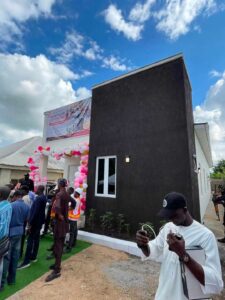
The daughter of Senator Natasha Akpoti-Uduaghan, representing Kogi Central Senatorial District in the National Assembly, Nadia recently commissioned and handed over a newly built and fully equipped orphanage home to Oyiza-Salem Divine Orphanage Home.
What began as an idea in the mind of a 15-year-old has become a physical reality: a modern residential facility created to provide shelter, security, comfort and hope for children who have known the pain of circumstances beyond their control.
The commissioning ceremony was an emotional occasion. Community leaders, religious figures, residents, children and well-wishers gathered to witness the formal handover of the facility.
But for the children of Oyiza-Salem Divine Orphanage Home, the significance of the occasion went far beyond the ceremony.
It was the moment a difficult chapter gave way to a new beginning.
The facility, funded through resources mobilised by Nadia with support from family members, friends and members of the public, represents a remarkable example of what can happen when compassion is matched by determination.
For Nadia, however, the journey was never simply about constructing a building.
It was about answering a question that had been quietly troubling her.
“About a year ago, this was simply an idea. I wanted to do something meaningful for children who, through no fault of their own, have not had some of the opportunities that many of us take for granted,” she said.
Growing up in what she described as a loving and supportive family made her reflect on children whose childhoods had been shaped by very different circumstances.
“I have been blessed to grow up in a loving and supportive home, surrounded by people who care for me. And I found myself asking: What about the children who didn’t get that same chance? Don’t they deserve to feel safe, loved and cared for too?” she asked.
That simple question became the seed of a project that would eventually change the lives of dozens of children.
The task, however, was daunting.
At 15, Nadia had neither the financial capacity nor the experience normally associated with a project of such magnitude. Raising enough money to construct and equip an orphanage seemed almost impossible.
But she decided to try.
“At first, raising enough money to build an orphanage seemed almost impossible. I was only 15, and I had never done anything like this before. But I decided to try,” she recalled.
And people responded.
Through the generosity of family members, friends and even strangers, the young philanthropist was able to mobilise sufficient resources not only to construct the building but also to furnish and equip it.
“With the incredible generosity of my family, friends and even complete strangers, we raised enough not only to build this home, but also to furnish every room.
“And today, what started as an idea has become a home,” she said.
Those words perhaps best capture the extraordinary journey of the project.
An idea became a campaign.
The campaign became a building.
And the building became a home.
For the children, it is a home that carries an even deeper promise — the promise that they are seen, valued and worthy of a future.
A Mother’s Legacy, A Daughter’s Example
The project has also drawn attention to the values that Senator Natasha Akpoti-Uduaghan has consistently projected through her public engagement and community-oriented initiatives.
But in a striking revelation at the ceremony, the senator made it clear that the orphanage project was her daughter’s own initiative.
“My daughter, Nadia, sourced the money spent on the building by herself without me contributing one kobo to the project,” Senator Natasha said.
The statement was significant.
It underscored not only Nadia’s independence but also the possibility that values of compassion, service and responsibility can be transmitted from one generation to another.
The senator also revealed that her daughter was already contemplating another humanitarian intervention — a heavily equipped care home for pregnant women in Kogi Central.
“She is already developing a plan to build a heavily equipped care home for pregnant women in Kogi Central,” she announced.
For a mother whose public life has been closely associated with advocacy and community development, the emergence of such an initiative from her teenage daughter represents more than a personal achievement.
It is a powerful reminder that philanthropy can become a culture — one generation inspiring the next to see public service not merely as a political responsibility but as a moral obligation.
Senator Natasha commended her daughter’s initiative, describing it as evidence of what young people can achieve when compassion is combined with determination and a sense of responsibility.
From Sleeping on the Floor to a Home of Dignity
Perhaps no one understands the significance of the intervention more deeply than Pastor Kisito Adomu Zuberu, founder of Oyiza-Salem Divine Orphanage Home.
His account of the children’s previous living conditions brought an emotional dimension to the ceremony.
“When they came last year, the children were sleeping on the ground, but today Miss Nadia Zakari has given us a fully equipped mansion,” he said.
The contrast is stark.
Children who once had to sleep on the floor now have a purpose-built facility designed to offer them a safer and more conducive environment.
Yet the story of Oyiza-Salem is not one of deprivation alone.
Despite its limited resources, the orphanage has continued to invest in the education and development of the children in its care.
Pastor Zuberu disclosed that two of the children had been sent to university. One is studying at the School of Nursing, Obangede, while another, Alhassan, has graduated from the University of Abuja. Another is studying at Kwara State University, while one is awaiting National Youth Service Corps mobilisation.
Eight children are currently in primary school, while two others are learning vocational skills, including tailoring.
These details offer a glimpse into what the intervention means.
The new building is not simply a shelter. It is an infrastructure of possibility.
It provides the physical environment from which education, skills acquisition, confidence and ambition can grow.
A Message to Young Nigerians
Nadia has also turned her experience into a message to other young people.
She does not believe that philanthropy should be postponed until adulthood, wealth or political influence.
“This experience has taught me something that I hope other young people will remember: You don’t have to wait until you are older, richer or more powerful to make a difference. You just have to care enough to start,” she said.
That message may ultimately prove to be one of the most important legacies of the project.
In a society where young people are sometimes portrayed primarily as beneficiaries of government and charitable interventions, Nadia has offered another image — that of a young person who identifies a problem, mobilises others and takes responsibility for creating a solution.
She also expressed profound gratitude to everyone who supported the initiative.
“To every single person who donated, shared my message, encouraged me or simply believed in this project, thank you from the bottom of my heart. This would not have been possible without you,” she said.
But perhaps her most touching words were reserved for the children themselves.
“I hope you always know that you are loved, you matter and your dreams matter.
“May this home be a place where you feel safe, where you laugh, where you grow, and where you are never afraid to dream big.”
Those words capture the heart of the project.
A building can provide shelter, but it takes compassion to make it a home.
More Than Bricks and Mortar
For the management, staff and children of Oyiza-Salem Divine Orphanage Home, the intervention represents far more than the construction of a modern residential complex.
It is a declaration of love.
It is a restoration of dignity.
It is a message to children who might otherwise feel forgotten that their lives matter and that strangers can care deeply enough to change their circumstances.
The institution expressed its appreciation to Nadia and Senator Natasha for the intervention, describing the project as a demonstration of compassion that has given the children renewed hope, security and dignity.
The commissioning was attended by community leaders, residents and other dignitaries, many of whom applauded the initiative as an inspiring example of youth-led philanthropy in Kogi State.
And as the doors of the new facility opened, the significance of the occasion extended beyond Etahi Community.
It became a story about the power of example.
A story about a mother whose public commitment to community development has helped create an environment in which her daughter has learned that leadership is not merely about holding office.
It is about service.
It is about seeing suffering and refusing to look away.
It is about understanding that development is not always measured in kilometres of roads, public buildings or political achievements, but sometimes in something as basic — and as profound — as giving a child a safe place to sleep.
Nadia’s project has also demonstrated that philanthropy does not always require enormous wealth.
Sometimes, it requires an idea, courage, persistence and the ability to persuade others to believe in that idea.
At 15, Nadia asked a simple question: What about the children who did not get the same chance I had?
At 16, she has answered that question with a home.
And perhaps that is the most enduring lesson of her story.
Meaningful change does not always begin with age, wealth or political influence.
Sometimes, it begins with compassion.
Sometimes, it begins with a question.
And sometimes, it begins with a young girl who decides that caring is not enough — and chooses to act.
Dear readers, we really need your support to keep on serving you with authoritative, truthful, and juicy stories everyday. For your support, please reach out to the editor @gavelinternational66@gmail.com