

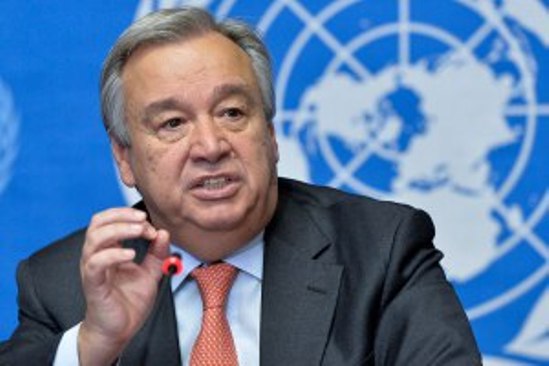

United Nations Secretary-General Antonio Guterres has renewed his call for sweeping reform of the UN Security Council, declaring the continued exclusion of Africa from permanent membership of the 15-member body “unjust and indefensible.”
Guterres made the declaration on Tuesday while opening the General Debate of the 81st session of the UN General Assembly at the UN headquarters in New York.
With about 100 days remaining in his tenure, the UN chief used his address to warn that global power structures were increasingly out of step with the realities of the modern world.
He said the composition of the Security Council no longer reflected contemporary geopolitical realities, making reform an urgent necessity.
“The fault lines in our world are widening. Cracks have become canyons,” Guterres said, warning that the international system was being weakened by deepening inequality, conflicts and the erosion of international norms.
He linked the question of Security Council reform to a wider struggle over who exercises power and who benefits from global political and economic systems.
Guterres also criticised the international financial architecture, saying developing countries were being trapped by heavy debt burdens while confronting climate-related disasters they had contributed little to causing.
He called for accelerated debt relief, stronger multilateral development banks and fairer access to the International Monetary Fund’s Special Drawing Rights.
On conflicts around the world, including those in the Middle East, Ukraine, Sudan and Myanmar, the UN chief said many ceasefires had delivered little more than temporary reductions in violence while civilians continued to pay the highest price.
He renewed his call for compliance with International Court of Justice orders concerning Gaza and warned that continued settlement expansion in the Israeli-occupied West Bank was threatening the prospects of a two-state solution.
Guterres also condemned Russia’s full-scale invasion of Ukraine as a violation of the UN Charter.
Turning to climate change, he described the crisis as the “most profound intergenerational power imbalance” and warned that the world was approaching a point where the 1.5-degree Celsius temperature threshold could be breached.
He called for major polluters to pay and urged developed countries to triple adaptation finance for vulnerable nations.
The secretary-general also warned that artificial intelligence was concentrating power in data, computing capacity and algorithms at a pace that was outstripping the world’s ability to regulate the technology.
“The danger is not technology. The danger is technology without accountability,” he said.
Guterres called for a multilateral framework to manage AI risks, backed by independent oversight. He said children should never become test subjects for unregulated AI systems and that decisions involving life and death should never be surrendered to machines.
“Killer robots must have no place in our future,” he said.
On gender equality, Guterres announced that the UN had achieved full gender parity across its senior leadership, headquarters staff and professional roles for the first time in its history.
“Equality is not a dream; it is a decision,” he said, presenting the UN’s progress as evidence that entrenched power structures could be changed.
Guterres said the erosion of international norms, including attacks on civilians and humanitarian workers and the growing disregard for international law, demonstrated the need for stronger multilateral cooperation.
He warned against a world divided into rival blocs with separate economic and security systems — a fragmentation he has previously described as the “Great Fracture.”
The UN chief reaffirmed that peace, development and human rights remained inseparable pillars of the UN Charter.
He said the organisation, founded more than eight decades ago after World War II, represented an effort by nations to recognise that their futures were interconnected.
Guterres pledged to defend those principles for the remainder of his tenure and beyond.
“The world does not need a weaker United Nations,” he said.
“It needs a UN strong enough to face the world as it is and determined enough to build the world as it should be.”
Dear readers, we really need your support to keep on serving you with authoritative, truthful, and juicy stories everyday. For your support, please reach out to the editor @gavelinternational66@gmail.com