

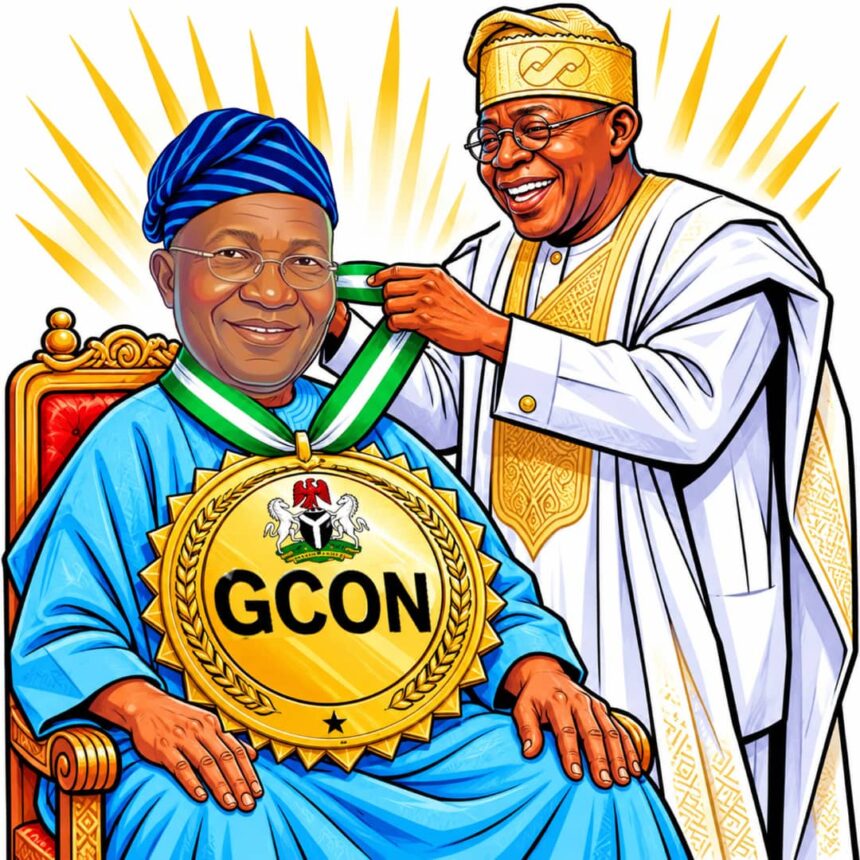

By Kolawole Igandan.
“I hereby confer on Chief Wole Olanipekun the rank of Grand Commander of the Order of the Niger”
Chief Wole Olanipekun stood bewildered and transfixed. For a moment, he channeled his gaze deeply at the Special Guest of Honour of the high octane event, hoping he heard him right or he was possibly soliloquizing.
The pronouncement changed the proceedings of the event. The Jagaban Borgu who always knew the right moment to score a point made the pronouncement when the curtain was drawing on the event.
For once, Olanipekun, who has never been at a loss for words in 50 years at the Bar; who has stood before the Supreme Court over 400 times and never trembled, lost his composure.
The entire audience watched in motionless disbelief as the President and Commander-in-Chief of the Armed Forces of the Federal Republic of Nigeria, Asiwaju Bola Ahmed Tinubu did the unthinkable at the most auspicious moment.
Chief Wole Olanipekun, SAN, thought the President’s physical presence at the book unveiling was enough honour . But President Bola Ahmed Tinubu had come with a thunderbolt in his breast pocket.
That thunderbolt was GCON — the Grand Commander of the Order of the Niger — Nigeria’s second-highest national honour, ranking only below the President’s GCFR. And yesterday, Thursday, November 19, 2026, at the Body of Benchers Complex, Abuja, at the WOC Justice Summit, the President conferred the prestigious award of GCON as a befitting birthday gift to Chief Wole Olanipekun,SAN.
HISTORY IN THE MAKING
The hall was already a conclave of power. Senate President Godswill Akpabio, FCT Minister Nyesom Wike, Ekiti Governor Biodun Oyebanji, Chief Justice of Nigeria Hon. Justice Kudirat Kekere-Ekun, Attorney-General Prince Lateef Fagbemi, SAN, business titan Tony Elumelu, Life Benchers, Senior Advocates, Generals and Royal Fathers. All had gathered for a triple jubilee: a 75th birthday on November 18, 50 years at the Bar since July 1976, 35 years as Senior Advocate since July 1991, and the unveiling of a six-volume magnum opus — _Wole Olanipekun: Through The Cases 1976-2026_.
But the President was the last to speak. And when he spoke, he turned a book launch into a coronation.
“MY FRIEND, MY BROTHER AND MY CONFIDANT” — TINUBU AND HIS WOLE
President Tinubu opened with a line that set the hall ablaze. He looked at Olanipekun, smiled, and said:
_”My friend, my brother and my confidant.”_
It was not presidential protocol. It was personal. It was brotherhood.
“On a personal note, I celebrate decades of loyalty, friendship, commitment and reciprocity between Wole Olanipekun and me. He has led my legal team for decades in politics. Friends come and go. Wole came and Wole stayed. Thank you very much.”
“We have been together in war rooms, planning, brainstorming and debating strategy for my own cases and for the cases of others whom I regularly bring to his door.”
“Some of the epic legal battles he fought on my behalf are contained in the volumes we are presenting today.”
Tinubu revealed he had been up till 2:30 a.m. solving political problems and structuring his campaign, doubting if he would make it, but told himself: “For Wole Olanipekun, I have to stay awake.”
Then came the record that stunned even senior lawyers:
“Wole led the legal team that defended three of my predecessors when their elections were challenged. He has therefore been lead counsel to four successful Presidents of the Federal Republic of Nigeria since 2007. Presidents change, parties change, the lead counsel remains. That record is unprecedented in Nigeria.”
“As President of the Federal Republic of Nigeria, I proudly celebrate Chief Wole Olanipekun, Senior Advocate of Nigeria, a phenomenon in Nigeria and an outstanding advocate who has fittingly stepped into the shoes of the acclaimed legends of the legal profession. He did not merely fill those shoes, he is walking with them into new territory.”
“Whenever I hand a matter to Olanipekun, I sleep soundly. I cannot promise that the other side sleeps as well.”
And then the mischief, the Tinubu humour that brought the roof down:
“Some of our friends in the opposition have also read these cases. They benefited from you, though not by choice. They were the other party. For them, this is not a book launch. It is a reunion.”
“I have directed that Wole Olanipekun’s book be delivered to my friends in the opposition. They don’t have to pay for it. I will fund it. If you ever find yourself in court again, please find your own Wole Olanipekun, because this one here is already taken, booked, and ready for 2027.”
He closed with a statesman’s creed:
“Our administration respects court judgments, even the ones we do not enjoy reading. We do not denigrate, attack or intimidate the judiciary. A government that bullies its judges only weakens its own foundation.”
And then, the line that made history:
_”I hereby confer on Chief Wole Olanipekun the rank of Grand Commander of the Order of the Niger.”_
The hall exploded. The new GCON was transfixed. The making of a GCON was complete.
But before that Presidential thunder, the day had built its own drama:
GOVERNOR BIODUN OYEBANJI: EKITI STANDS PROUD
Governor of Ekiti State, Mr. Biodun Oyebanji, was the first to claim ownership. With palpable pride, he told the gathering that Ekiti State was proud of Olanipekun.
The Governor eulogised him for enriching the legal profession, but went beyond law. He commended Olanipekun for his immense contributions to Ekiti — in education, health, human capital development and mentoring of the younger generation. For Oyebanji, this was not just a legal icon; this was Ekiti’s most distinguished son, the Asiwaju of Ikere, who had built schools, hospitals and futures long before he built the six volumes.
TONY ELUMELU: LAW IS BUSINESS
Chairman of Heirs Holdings and UBA, Tony Elumelu, delivered the keynote — _”The Rule of Law as a Catalyst for Private Sector Growth and Economic Transformation.”_
Elumelu was clinical. He told the summit that investors do not first read a country’s balance sheet; they read its court judgments. “Every timely judgment is an advertisement for the Nigerian economy,” he echoed, aligning with Tinubu, adding: “Before power, before rules, before tax incentives, the best condition is a court judgment that is fair, impartial and timely.” He praised Tinubu’s reforms — Yemi Cardoso at CBN, Zacch Adedeji at FIRS — but warned: justice delayed is investment denied.
NYESOM WIKE: THE BULLDOZER SALUTES THE COLOSSUS
FCT Minister Nyesom Wike came with his trademark bluntness. No notes.
“Wole Olanipekun does not know how to lose a constitutional argument,” Wike boomed. “When Ladoja was illegally impeached, it was Wole who taught this country that impeachment is not mathematics, it is constitutionalism. Inakoju v. Adeleke is not just a case, it is our democracy’s insurance policy.”
PROF. LANRE FAGBOHUN: THE SCHOLAR AS REVIEWER
Former Vice-Chancellor of Lagos State University, Prof. Olanrewaju Fagbohun, SAN, first reviewer of the six volumes, took the scalpel. He described the books as not biography but autopsy of Nigerian law. Volume by volume, he showed how Olanipekun’s arguments in electoral law, banking, chieftaincy and fundamental rights became the law itself. “This is jurisprudential archaeology,” Fagbohun said. “You dig through these cases, you find the DNA of modern Nigeria.”
PROF. FABIAN AJOGWU: THE REVIEWER AS PROPHET
Prof. Fabian Ajogwu, OFR, SAN, the corporate governance guru, took it higher. “This is not Through The Cases as nostalgia; it is Through The Cases as methodology,” Ajogwu declared. “Olanipekun taught us that a brief is not a document; it is a destiny. He writes briefs like Chinua Achebe wrote novels — every comma earns its place.” He noted the forewords by CJN Kekere-Ekun and AGF Fagbemi as proof that the Bench and the Bar agree with the author.
HON. JUSTICE KUDIRAT KEKERE-EKUN: THE CJN’S VERDICT
Then, the Chief Justice of Nigeria, Hon. Justice Kudirat Kekere-Ekun, GCON, who wrote the foreword, rose. The hall fell silent.
She did not speak as a guest. She spoke as the ultimate witness.
“Chief Olanipekun is an advocate whose presentation in court commands attention,” she said. “It would be a miss not to acknowledge his exceptional gift of oral advocacy. He possesses a remarkable ability to marshal his arguments, deploy the authorities, and present his client’s case with such conviction, clarity and persuasive force that at times one could almost find oneself persuaded in his favour simply by the eloquence and strength of his presentation.”
“That, indeed, is the art of advocacy: the ability to engage the intellect, command attention, and make a compelling case while leaving the ultimate determination, as it must, to the independent judgment of the court.”
She concluded that the six volumes would “further contribute to the intellectual depth, advocacy and enrichment of the nation’s jurisprudence.”
It was the Bench crowning its finest advocate.
THE PANEL DISCUSSION:
BODE OLANIPEKUN LEADS THE FUTURE
Then came the symbolic handover. The panel discussion, moderated by Bode Olanipekun, SAN, leading discussants Miannaya Essien, SAN, Prof. Dakas Dakas, SAN, Chairman of the Nigerian Law Reform Commission, and others, was themed: _”From Precedent to Possibility: The Lawyer’s Role in Shaping the Next Fifty Years of Justice, Democracy and Public Trust.”_
Bode did not speak as a son, but as a Silk. Calm, cerebral, precise. The panel debated AI and justice, speedy trials and investor confidence. And the symbolism was unmissable: the father had written Through The Cases; the son was now leading Through The Possibilities.
FINALLY, THE COLOSSUS SPEAKS — AND ADMONISHES
Chief Wole Olanipekun, GCON, finally rose — overwhelmed, eyes misty behind his glasses, his shoes gleaming, his watch ticking.
He spoke of Tinubu from 1992, when he was Attorney-General of old Ondo State and Tinubu, then Senator, told General Babangida at the National Assembly inauguration: “We Senators have an insurable interest in democracy because one day people like us want to govern this country.”
“You said it; it came to pass. We started. It was then I got attracted to you, Your Excellency,” Olanipekun said.
He recalled the nocturnal meeting at Agoro Odiyan Street, residence of the late Senator O. J. Adewumi, where Tinubu and others briefed him and the late G.O.K. Ajayi, SAN, to challenge General Abacha’s dissolution of the National Assembly.
He also recalled the phone call — Tinubu waking him up: “SAN, have you heard that the President said he has removed the governor of Oyo State? What are you doing about it?
” Then the instruction: “Please go and set up a team to fight it. This democracy will collapse if you allow governors to be removed that way.”
That became Inakoju. That became law”.
Then he turned to his colleagues — and admonished them to support Chief Justice Kudirat Kekere-Ekun: “When women are in charge, things change, and we know things are changing.”
“Let us put aside our differences from the last election. I did not support the emergence of Oyinkansola Badejo-Okusanya as NBA President, but she has won. Let us extend the olive branch, come together to reinvent the NBA and make it thick.”
It was vintage Olanipekun: loyal to friends, respectful to the Bench, father to the Bar.
He ended with commendation to his wife, Erelu Omolara, and to Ikere, which adores him.
He left the stage a GCON, but still the boy with humble beginnings from Amoye Grammar School — the boy who became the law.
Igandan is a media consultant.
Dear readers, we really need your support to keep on serving you with authoritative, truthful, and juicy stories everyday. For your support, please reach out to the editor @gavelinternational66@gmail.com