
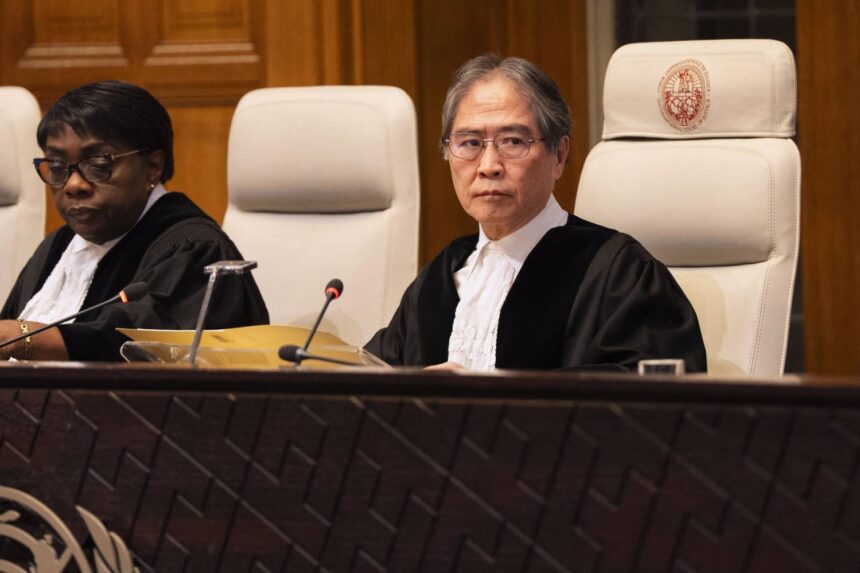

The International Court of Justice (ICJ) has ruled that Myanmar committed genocide against its Rohingya Muslim minority during the military crackdown in northern Rakhine State in 2017.
In a landmark judgment delivered on Thursday, November 19, 2026, the United Nations’ highest court found Myanmar responsible for genocide following a campaign of mass killings, sexual violence, forced displacement and other atrocities against the minority group.
The ruling came in a case filed by The Gambia in 2019, which accused Myanmar of violating the 1948 Genocide Convention through its military operations against the Rohingya population.
The court reached its decision by a 9-6 majority, marking the first time in its history that it has held a state responsible for committing genocide. The judgment is final and cannot be appealed. <Cite refs={[“turn909342news13″,”turn909342search5″,”turn909342search2”]}/>
During the proceedings, the court concluded that “genocidal intent is the only reasonable inference that can be drawn from the evidence” presented.
The military crackdown followed deadly attacks by fighters from the Arakan Rohingya Salvation Army (ARSA) on more than 30 police posts. Myanmar’s security forces subsequently launched what they described as clearance operations, triggering a mass exodus of Rohingya from the country.
Thousands were reportedly killed, while more than 700,000 Rohingya fled to neighbouring Bangladesh. Survivors and witnesses recounted how villages were destroyed, civilians were killed and women and girls were subjected to rape and other forms of sexual violence.
The ICJ found that approximately 10,000 Rohingya were violently killed during the operations. It also established that Myanmar’s security forces committed killings, widespread sexual violence, extreme violence against children and deliberately destroyed homes.
The court further found that troops attacked Rohingya civilians as they attempted to escape to Bangladesh.
It also identified extensive destruction of evidence, including the burning and disposal of bodies and the bulldozing of cleared sites, as well as failures to investigate and prosecute those responsible.
Although the court acknowledged the role played by ARSA in the events leading to the crackdown, it found that anti-Rohingya hate speech and the military operations overlapped, contributing to an environment in which violence against the minority group was more likely.
Myanmar had consistently denied committing genocide, maintaining that its military operations were aimed at militant threats following the ARSA attacks.
In its judgment, the ICJ ordered Myanmar to investigate and, where appropriate, prosecute those suspected of committing genocide-related offences. It also directed the country to take steps to prevent further violations, provide guarantees of non-repetition and compensate the victims.
The court further called for measures to facilitate the safe, voluntary and dignified return of displaced Rohingya to their places of residence, as well as the reunification of separated families. The question of the amount and modalities of compensation will be determined in a subsequent phase of the proceedings. <Cite refs={[“turn909342search12″,”turn909342search15″,”turn909342search2”]}/>
The ruling has been welcomed by Rohingya communities and human rights organisations, which described it as a significant step towards justice for victims of the atrocities.
“This is like formal recognition of our suffering,” said Mohammed Nowkim, a Rohingya who fled Rakhine State in 2017 and now lives in Canada.
“The Rohingya have been waiting for justice for decades,” he added.
Human Rights Watch also described the judgment as long-awaited recognition of the suffering endured by the Rohingya.
Meanwhile, UN human rights chief Volker Türk said the “suffering, misery and humiliation” inflicted on the community represented a stain on humanity’s conscience.
He called for the court’s decision to be translated into concrete action.
The judgment is considered a major development in the long-running quest for accountability over the persecution of the Rohingya, thousands of whom remain displaced outside Myanmar.
Dear readers, we really need your support to keep on serving you with authoritative, truthful, and juicy stories everyday. For your support, please reach out to the editor @gavelinternational66@gmail.com