
By Kingsley Osadolor
Sometime in 1993, before the June 12 tumult set in, and about a year after I became Editor of The Guardian on Sunday, I received a minute from Lade Bonuola (Ladbone), who was the Managing Director of Guardian Newspapers Limited. The minute was on an invitation to a cocktail at Victoria Island, Lagos. The MD said he would not be able to attend, but that I should represent him at the event. The cocktail was hosted by the former Chief of Army Staff and business mogul, Lt.-Gen. T.Y. Danjuma (rtd), and his wife, Daisy, at their Victoria Island home, long before they relocated to Banana Island.
A number of corporate titans attended the cocktail. They included Dr. Christopher Kolade, Pascal Dozie, Faysal el-Khalil of Seven-Up, and others. There was also in attendance Prof. Albert Alós. Part of the talk at the event was a call for corporate support for the effective take-off of the Lagos Business School. The solicited support was by way of endowments or other donations, or dedicated funding, so that brick by brick the School could grow and set a reputation for standard, especially in executive business education. There were also, from among the corporate bigwigs present, pledges of faculty time, so there could be a productive meeting of town and gown. That way, the highly practiced hands could more readily impart knowledge through elucidation with case studies.
In the ensuing years, Dr. Kolade became perhaps the best exemplification of the primal pledge of adjunct faculty time by the corporate heavyweights. It was at that cocktail that one of the speakers suggested that, if corporate entities in the country sent in their executives for programmes at the School, it would incentivize non-stop improvement and bolster the School’s profile. That plea bore fruit bountifully in later years as the Lagos Business School boasted of an alumni database that included operatives and key decision-makers of blue-chip companies and other well-heeled enterprises.
Meeting him for the first time, but struck by his quiet yet confident demeanour, I got into small talk with Prof Alós, as he sidled up to me at the cocktail, and we exchanged business cards. Alós equally introduced another gentleman to me whom he said was involved with the Lagos Business School project and would in the meantime manage the public relations dimensions of the institution. That gentleman was Timothy Keenly with whom I also exchanged business cards. After the cocktail, I did not return to the office, but drove home instead, as it was already nighttime.
The next day, I went to brief Lade Bonuola about the event at which I represented him. He listened attentively to my summarized briefing, including an abridged roll-call of the participants. Then, I mentioned that Prof Alós had hinted that they would rely on us, The Guardian, to help promote the endowments of the Lagos Business School project. At that, Ladbone’s face lit up—and he said, “Oh yes, yes! From the names you reeled out, these are serious-minded Nigerians, and it is a measure of our reputation as a newspaper that they are seeking reliance on our support.”
The support we gave as a newspaper was publicity at no cost whatsoever. Later, as the corporate entities and individuals redeemed their pledges to the School, the cheques were usually received on behalf of the Lagos Business School by Timothy Keenly, and it was always as a photo opportunity. Timothy Keenly would dispatch the photographs to me with captions. I got them published as a photo story in the Business section of The Guardian on Sunday. As Timothy Keenly, Prof Alós, and Prof John Elegido confirmed to me subsequently, on separate occasions, that simple gesture of publicizing Timothy Keenly receiving endowment cheques on behalf of the School encouraged even more donors. And from Ahmed Onibudo Street, where the Lagos Business School took off effectively, it became the premier, foundational School at the Pan-Atlantic University of which Prof. Alós was the inaugural Vice-Chancellor, before his retirement at age 70.
One day, in late 2010, I ran into Prof Elegido at the basement lobby of NICON Luxury Hotel in Abuja. I introduced myself to him, and asked after both Prof Alós and Timothy Keenly. I reminded him about the early days of endowments for the Lagos Business School. Prof Elegido remembered clearly, and teased that Timothy Keenly’s face was in The Guardian every so often. Keenly, he said, had since returned to the United States. Because Lade Bonuola had approved the editorial support for the Lagos Business School project endowment, no one queried why The Guardian on Sunday so regularly published photonews about the School. The Lagos Business School firmed up, and began its ascent to the stars. The closest I ever came to the School was when it was still located at Ahmed Onibudo Street, near the Nigerian Law School. I would park opposite the Business School and stroll into the Law School when I was enrolled therein, and return to my car after lectures, scampering to beat the traffic on Victoria Island.
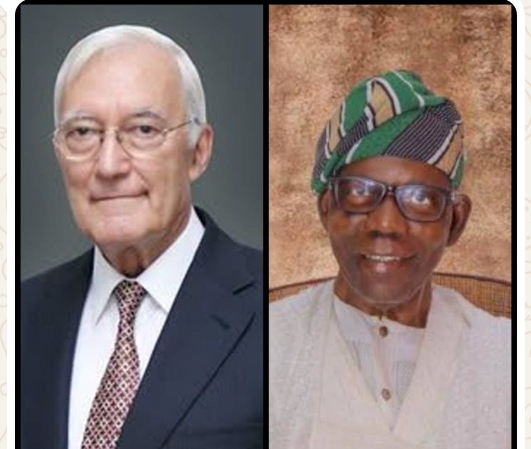
On September 7, 2026, Prof Albert Alós died, just 10 days shy of his 87th birthday. Originally from Spain, he arrived in Nigeria in 1967, the year our country’s 30-month Civil War broke out. Alós became naturalized and truly called Nigeria his home, while flourishing as an academic in his core field of Electrical Engineering in Universities at Ife, Lagos, and Ibadan. Unquestionably, however, it was the Lagos Business School, as well as Pan-Atlantic University, that cemented his legacy of remarkable educational institutional development, which Ladbone, and I to a lesser degree, helped to galvanize the watering-can bearers, who hearkened to the clarion call at Gen. Danjuma’s cocktail party, to ensure the germination of the seed that had been consciously planted in the early ’90s—-and now an oak in Nigeria’s educational landscape.
Osadolor, former Editor of The Guardian on Sunday, and later Deputy Managing Director of Guardian Newspapers Limited, is co-Host of Good Morning Nigeria on the Nigerian Television Authority network.
October 14, 2026
Dear readers, we really need your support to keep on serving you with authoritative, truthful, and juicy stories everyday. For your support, please reach out to the editor @gavelinternational66@gmail.com